

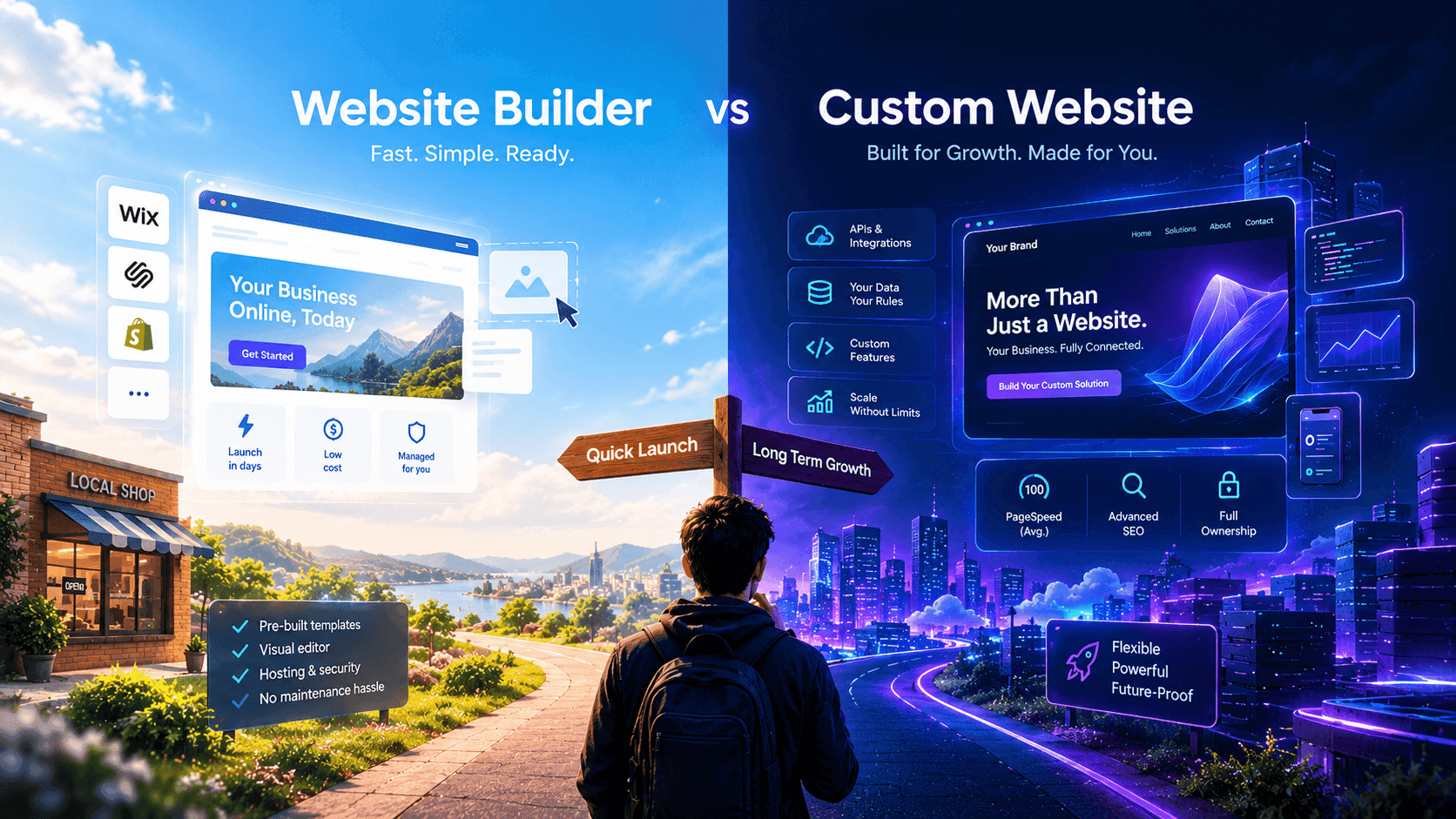
If you need a simple website live by tomorrow, use a website builder. If you need a digital asset that drives revenue, integrates with your internal systems, and scales without limits, you need a custom website.
Currently, 64% of U.S. small businesses use website builders. For early-stage startups and local brick-and-mortar businesses, platforms like Wix, Squarespace, and standard Shopify are excellent tools that lower the barrier to entry. However, as a business grows, the limitations of a rented platform, including code bloat, rigid templates, and closed ecosystems, can quickly become costly bottlenecks.
Here is a consultant-level breakdown of website builders versus custom web development, and how to know which route makes financial and operational sense for your current stage of business.
The Reality of Website Builders (Pros & Cons)
Website builders provide an all-in-one environment. You get hosting, pre-built templates, and a visual editor for a predictable monthly fee.
The Pros: You can launch in days instead of months. The initial cost is practically zero compared to hiring an agency. Maintenance, SSL certificates, and hosting security are handled entirely by the platform.
The Trade-Offs: You do not own the site; you rent it. You are locked into their ecosystem, meaning you cannot easily export your codebase to another host if you outgrow them. Furthermore, relying on drag-and-drop editors often results in "code bloat," which can negatively impact page speed and server response times.
The Strategic Advantage of a Custom Website
A custom website is built from the ground up by a web development team. Whether hand-coded or built on a heavily customized open-source framework (like a Headless CMS), the underlying architecture is dictated by your exact business needs, not a generic template.
The Pros: Total ownership of your codebase and data. You have unrestricted ability to integrate with third-party tools, legacy systems, or custom APIs. You also get granular control over technical SEO and Core Web Vitals. A 2025 HTTP Archive analysis showed that the median website builder site scored 62 on Google PageSpeed Insights for mobile, while custom-built sites averaged an 85.
The Trade-Offs: Custom web development requires a larger upfront financial investment and a longer timeline (typically 8 to 16 weeks). It also requires a dedicated internal team or an agency partner to handle ongoing maintenance, server updates, and strategic improvements.
4 Signs Your Business Needs a Custom Website
When does the cost of staying on a builder outweigh the price of a custom build? Look for these four triggers.
1. You Need Advanced Software Integrations
If your website needs to communicate seamlessly with specialized software, such as a complex Salesforce architecture, a custom ERP inventory management system, or a secure customer portal, website builders will fall short. Custom development allows engineers to build specific APIs that bridge these systems without relying on clunky, third-party plugins.
2. Lead Generation is Your Primary Revenue Source
A website builder starts with what a typical business in your industry looks like. A custom build starts with how your specific customers make purchasing decisions. When your site is your main sales engine, you need custom conversion flows, multi-step forms that route data into specific CRM pipelines, and hyper-fast load times to prevent visitor bounce rates.
3. Technical SEO is Non-Negotiable
While website builders have improved their basic SEO features significantly, they still restrict server-level optimizations. If you are competing for high-value search terms in saturated markets (like the US or UK), you need the ability to optimize database queries, implement advanced schema markup natively, and control your site's rendering path.
4. You Require Complex E-Commerce Functionality
Standard builders work perfectly for selling basic consumer products. However, if your e-commerce model involves dynamic tiered pricing, complex product configurators, multi-currency localized checkout, or wholesale (B2B) portals, you need custom e-commerce architecture built to handle that specific business logic.
The Verdict: Which Should You Choose?
Choose a website builder if you are testing a new idea, have a highly restricted budget, or only need a digital brochure.
Invest in custom web development when your website transitions from being a simple marketing asset to a core piece of your operational software. When you need specific functionality, deep integrations, and full ownership of your digital footprint, custom is the only viable path.
Ready to Build a Scalable Digital Asset?
At Planex, we specialize in transitioning growing businesses away from limiting platforms and into custom, high-performance web applications. Whether you need a headless e-commerce build, a complex CRM integration, or a lightning-fast corporate site, our engineering team has you covered.
Contact the Planex team today to discuss your custom web development needs.
Key Questions & Architectural Answers
Is a custom website automatically better for SEO than a website builder?
Can I migrate from a website builder to a custom website later?
Who owns the code and intellectual property with a custom-engineered web app?

Full-stack developer with 3+ years of experience delivering production-ready websites, e-commerce platforms, and custom business applications.