

Prostuti Case Study: Exam Prep Platform with 35,000+ MCQs
How Planex built Prostuti, a BCS, bank job and admission test prep platform in Bangladesh, with 35,000+ MCQs, live exams and a custom admin panel.
Services Delivered
Technologies Deployed
Business Outcomes & Impact
Engineering Case Study
Project Overview
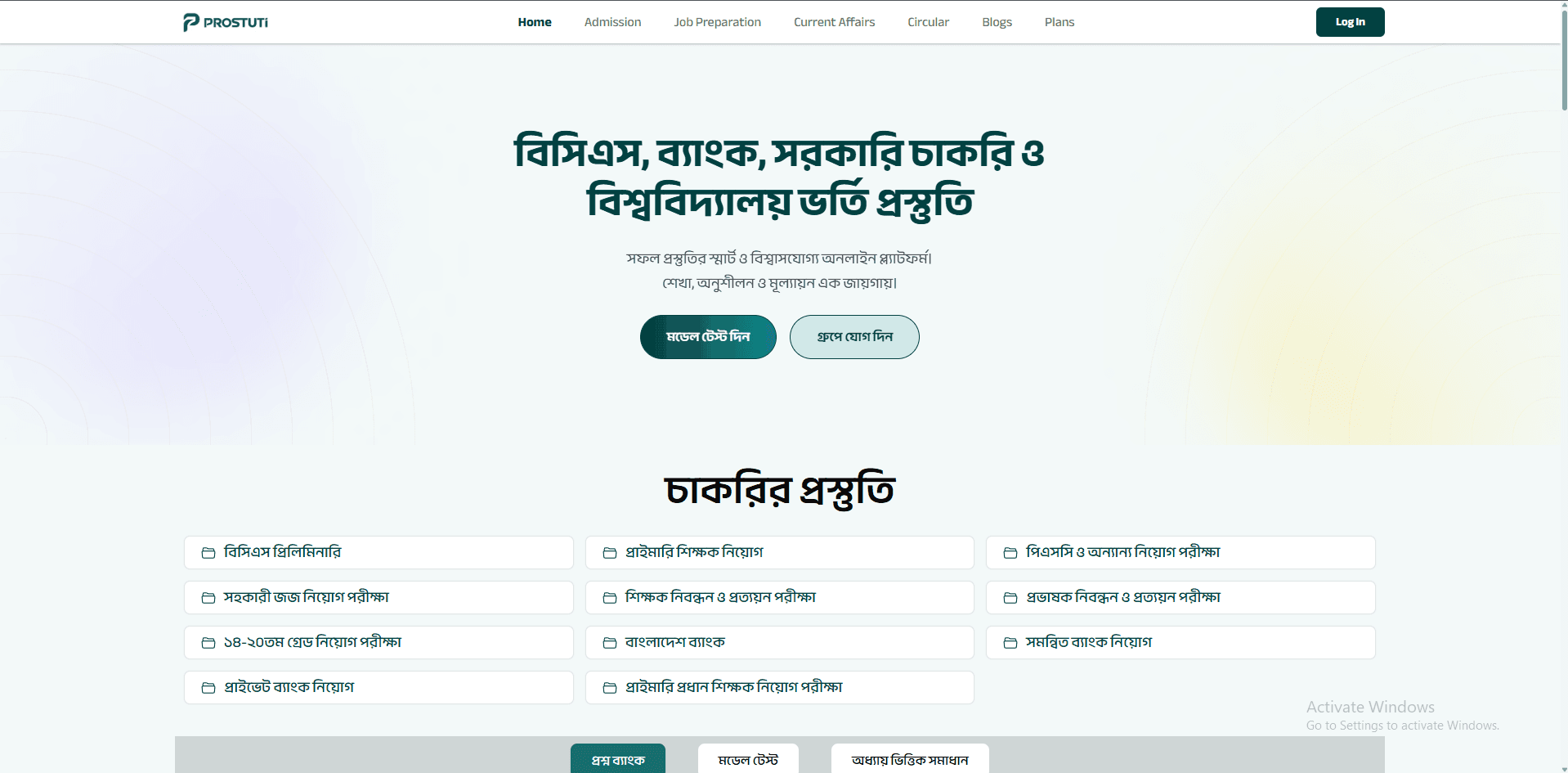
The Prostuti is an active, production-grade educational platform operating at theprostuti.com. The platform was conceived to solve a critical problem facing hundreds of thousands of candidates across Bangladesh: preparing effectively for high-stakes competitive examinations.
These exams include:
Bangladesh Civil Service (BCS) Preliminary and Written tests
Government ministry and directorate recruitment exams
State and private commercial bank recruitment exams
Primary School Assistant Teacher recruitment
Public university admission tests across Science, Arts, and Commerce disciplines
At the core of The Prostuti is an active, curated question library of over 35,000 multiple-choice questions (MCQs), complete with verified answer keys, detailed explanations in Bengali, and historical exam categorizations.
Planex was tasked with transforming an early educational concept into a robust, three-tier software ecosystem:
A fast, mobile-optimized student portal built for daily practice and timed examination simulations.
A feature-rich administrative dashboard allowing educators to manage multi-level academic taxonomies, author scientific questions with mathematical formulas, and monitor transactions.
A resilient Node.js and Express backend API connected to a structured MongoDB cluster, designed to handle concurrent test submissions and media processing.
The Challenge
Building an online examination and learning system at this scale presented distinct engineering and user-experience challenges:
High-Volume Question Management
Organizing more than 35,000 questions across multiple exam streams, subjects (Bangla, English, Mathematics, General Knowledge, General Science, and ICT), and granular subtopics required a database structure that supports fast filtering without complex, sluggish aggregation pipelines.
Realism Under Exam Conditions
Reading questions passively from physical guidebooks does not prepare candidates for real exam halls. The platform needed a live test engine with synchronized timers, negative marking calculations, and automated submission triggers. It was critical that accidental actions, such as tapping the browser back button or refreshing the tab on a phone, would not discard an active test session.
Complex Typography and Mathematical Notations
Questions frequently involve Bengali diacritics, conjunct characters, chemical formulas, and mathematical notation. The frontend had to render complex formatting cleanly across low-end mobile devices on 3G and 4G connections without visual distortion or layout shifts.
Operational Independence for Educators
Academic content creators are not software engineers. They needed an intuitive management interface to draft questions, attach rich explanations, format tables, schedule model tests, and verify payment slips without engineering assistance.
Discoverability and SEO Indexing
With tens of thousands of question pages, search engine crawlers needed accessible URLs and structured metadata. Without proper sitemap segmentation and server-side rendering, search bots would fail to index the platform effectively.
Our Approach
Planex adopted a modular, multi-application architecture. Rather than building a monolithic application that tries to satisfy both public users and internal staff in a single codebase, we engineered three focused applications:
Student Portal (Next.js 16 App Router & React 19): Combines Server Components for search engine pre-rendering with client components for interactive testing. This hybrid approach guarantees fast initial page loads for students browsing from mobile devices.
Administrative Dashboard (Vite & React 19): Designed as a dedicated Single Page Application. It provides academic editors with responsive data tables, live preview tools, and formula editors without impacting the public website bundle.
Central API Server (Express 5 & TypeScript): Handles business logic, role-based authorization, automated media compression pipelines, and transactional database updates.
We established a hierarchical data taxonomy in MongoDB. Instead of scattering categorization rules across different tables, we implemented a centralized filter schema that links Main Categories, Examination Categories, Groups, Units, Subjects, Topics, and Sub-Topics.
Platform Features
35,000+ Categorized Question Bank
Candidates can explore questions categorized by competitive examination, year of administration, subject, and subtopic. Each question card presents clear answer options, verified correct choices, and expandable explanations written in Bengali.
Dual-Mode Practice and Exam Engine
The platform provides two distinct user flows:
Study Mode: A relaxed, paginated browsing experience (25 questions per page) with subject filtering, question bookmarking, and on-demand answer reveals.
Live Exam Mode: A timed test interface with a live countdown clock, single-choice radio options, real-time progress indicators, and automated submission when the time runs out.
Defensive Exam Guard
To protect students from losing their progress during active tests, Planex implemented a custom exit guard. It monitors window lifecycle events and route changes, prompting confirmation dialogs before any action that could interrupt an active test.
Post-Exam Performance Breakdown
After completing a test, candidates receive an instant score modal detailing total marks, correct answers, incorrect answers, and negative marks. A dedicated review screen allows candidates to inspect every question individually, comparing their choices against correct answers with color-coded feedback and subject filters.
Candidate Dashboard
Authenticated students have access to a personal command center:
Historical exam attempts with scores and timestamps
A personal question bookmark library for quick revision before exams
A saved job circular repository to track application deadlines
Active subscription package status and remaining access duration
Scheduled Model Tests
Administrators can schedule full-length mock examinations with defined time windows, syllabus previews, pass criteria, and participant tracking.
Live Job Circulars Board
The platform includes an integrated employment board for government and private openings, displaying application deadlines, post counts, salary grades, and links to official circular documents.
Current Affairs and Practice Quizzes
A dedicated Current Affairs module publishes monthly national and international news summaries, paired with specialized practice questions to help candidates stay updated.
Administrative Control Suite
Educators manage the entire platform using a dedicated dashboard:
Question creator supporting WYSIWYG rich text and KaTeX formulas
Examination and model test scheduling modules
Taxonomy managers for subjects, units, groups, and topics
Payment slip verification workflow for bKash, Nagad, Rocket, and Upay orders
Role-based access control separating administrators and moderators
Technical Implementation
Hybrid Frontend Architecture
The student portal leverages Next.js 16 Server Components to fetch category metadata and initial question sets on the server. This provides search engines with pre-rendered HTML while delivering rapid First Contentful Paint times. Client-side interactions, such as subject tab switching and pagination, are managed via RTK Query with normalized tag caching, eliminating redundant network calls.
Modular Backend Architecture
The backend is built with Express 5 and TypeScript using a structured controller-service-model pattern. Incoming requests pass through Zod runtime validation schemas to prevent malformed data from reaching the database. Rate-limiting middleware guards sensitive routes, including authentication and user status toggles.
Database Design and Indexing Strategy
The MongoDB database uses targeted compound indexes on examination dates, slugs, and category identifiers. Questions are embedded directly within exam documents where atomic retrieval is beneficial, while cross-cutting data like candidate attempts, bookmarks, orders, and academic filters use dedicated reference models.
Automated Media Compression Pipeline
To maintain fast load times on cellular connections, all uploaded banners and question diagrams pass through an automated server pipeline. Incoming files are received in memory via Multer, resized and converted to optimized WebP format via Sharp, and streamed directly to Cloudinary.
Search Engine Optimization and Sharded Sitemaps
With over 35,000 question records, a standard single-file sitemap would exceed search engine file size and URL limits. Planex engineered a sharded sitemap architecture:
A central sitemap index referencing category-specific sitemaps
Sharded question sitemaps (/sitemaps/mcqs) and exam sitemaps (/sitemaps/exams)
Specialized sitemaps for circulars, current affairs, and blogs
Structured Schema.org JSON-LD data (WebSite, Organization, QAPage, and BreadcrumbList) embedded on relevant routes
Production Deployment and Server Architecture
The frontend and backend run on a dedicated Linux VPS environment managed with PM2 process manager for process clustering and automatic failure recovery. Nginx acts as a reverse proxy, handling SSL termination, gzip compression, and security headers configured via Helmet.
Results and Impact
35,000+ Verified MCQs Deployed: Delivered a structured repository that supports candidates across all major competitive exam disciplines in Bangladesh.
Uninterrupted Test Delivery: The live examination engine provides zero-latency timer synchronization, negative-marking calculations, and exit-guard protections that prevent accidental data loss.
Operational Independence: Educational staff independently manage thousands of questions, schedule model tests, and verify payment slips without technical intervention.
Consolidated Learning Experience: Replaced fragmented study methods (physical guidebooks, scattered PDFs, and social media groups) with a single platform combining question banks, live tests, current affairs, and job notices.
The Prostuti demonstrates Planex's ability to take a complex educational project with significant data volume and engineer an integrated, production-ready solution. By separating student interactions, administrative workflows, and backend processing into specialized tiers, Planex delivered a digital product that remains fast, reliable, and straightforward to maintain as its content library grows.
Have a project in mind? Let's build it together.
Planex delivers custom business software, scalable web applications, and high-performance digital products with fixed milestone pricing.