

Adil Traders: Wholesale & Retail ERP with Bengali POS Invoicing
How Planex engineered an enterprise inventory, dual-tier wholesale and retail POS, trade credit ledger, and Bengali cash memo system for M/S Adil Traders.
Services Delivered
Technologies Deployed
Business Outcomes & Impact
Engineering Case Study
Project Overview
M/S Adil Traders is an established commercial trading business operating in Bangladesh. The company supplies goods across two distinct customer segments: wholesale buyers who purchase in bulk quantities under negotiated trade rates, and walk-in retail shoppers purchasing individual units or weight-based goods.
As trading volumes grew, the operational mechanics of running the business through paper notebooks, verbal agreements, and traditional tally sheets broke down. Planex was brought in to build a centralized, web-based business management system and point-of-sale portal. The system had to unify inventory control, dual-tier pricing, fractional weight calculations, customer credit tracking, and financial reporting into a single operational hub that floor staff could operate without friction.
The Problem: What Needed to Change?
Wholesale and retail trade in Bangladesh moves quickly, especially during morning market rushes and bulk dispatch windows. In this environment, relying on manual paper vouchers created critical operational vulnerabilities:
Pricing Inconsistencies and Floor-Price Violations: The business manages multiple pricing tiers for every item: wholesale rates for bulk stockists, retail rates for everyday customers, and custom negotiated spot rates. On paper, sales staff frequently made mental math errors or applied arbitrary discounts. Items were occasionally sold below the store's minimum allowable threshold, eroding gross margins without management knowing.
The Mental Math of Weight vs. Piece Units: Unlike consumer retail stores that only sell pre-packaged items, Adil Traders deals simultaneously in discrete pieces (পিস) and weight-based bulk commodities (কেজি). Calculating fractional weights by hand under queue pressure led to calculation mistakes, slow customer turnover, and cashier frustration.
Uncontrolled Customer Credit ("Baki"): Trade credit is central to wholesale commerce. Regular dealers rarely settle every invoice in full on the spot. In physical books, tracking partial payments and calculating outstanding customer debt was cumbersome, causing cash-flow bottlenecks and reconciliation disputes.
Disconnected Stock and Inventory Blindspots: Stock was tracked through periodic manual counts. High-demand goods frequently stocked out without advance warning, while capital remained locked up in slow-moving items. When goods were returned, manual records rarely updated warehouse counts correctly.
Financial Blindspots and Lack of Role Separation: Management had to spend hours tallying receipts to determine profitability. Concurrently, business owners could not allow cashiers to see sensitive trade profit margins or wholesale purchase costs.
Understanding the People Behind the Problem
The daily challenges of the manual workflow affected each stakeholder differently:
The Business Owners: Needed complete clarity on daily revenues, cash collections, gross margins, inventory valuation, and total customer credit without being physically tied to the shop counter fourteen hours a day.
Sales Staff and Cashiers: Needed a lightning-fast billing interface that allowed rapid product search, supported piece and kilogram units with a single click, and produced receipts in seconds.
Wholesale Dealers and Retail Customers: Required transparent, itemized cash vouchers with clear rates, discount visibility, and accurate outstanding balances in Bengali to maintain trust.
Warehouse Staff: Required automatic stock deduction upon invoice confirmation so physical fulfillment matched system records immediately.
Our Approach: Finding the Right Solution
Planex designed the solution around the operational rhythm of wholesale and retail trade:
Enforce Business Guardrails at the API Layer: Pricing rules and stock validations are verified on the server. If a cashier enters a price below the minimum threshold, the transaction is rejected automatically with a clear Bengali explanation.
Atomic Stock Deductions with Concurrency Safety: The backend groups requested quantities, sorts product IDs to prevent lock-order deadlocks, and verifies available inventory before committing the invoice.
Immutable Financial Snapshots: Every invoice captures an immutable snapshot of product names, units, purchase prices, and selling prices at that exact moment, keeping historical profit calculations accurate even if catalog prices change later.
Role-Based Financial Privacy: Administrators see Gross Profit, Profit Margin Percentage, and Cost of Goods Sold. Floor staff see only Cash Collected, Invoices Handled, and operational tools.
Native Bengali Localization: Dates, numbers, payment methods, and receipt labels render in natural Bengali, aligning with standard local business practices.
The Solution: What We Built
The completed application provides a cohesive set of tools built specifically for trading businesses:
Rapid Point-of-Sale & Invoice Engine: Debounced search by product name or SKU, instant unit switching between pieces and kilograms, quick weight selector buttons (0.25 kg, 0.5 kg, 1 kg, 5 kg), and flexible payment method selection (Cash, bKash, Nagad, Card).
Trade Credit & Due Collection Ledger: Dedicated due collection modals that log partial payments with timestamps and notes, automatically updating remaining balances and voucher payment status.
Product Returns & Restocking: Itemized return management with options to deduct return values from outstanding balances or issue cash refunds, automatically incrementing warehouse inventory counts.
Dual-Format Document Printing: Clean printable A4 and thermal vouchers featuring shop branding, sequential invoice numbering (AT-YYMM-XXXX), customer details, and Bengali date formatting.
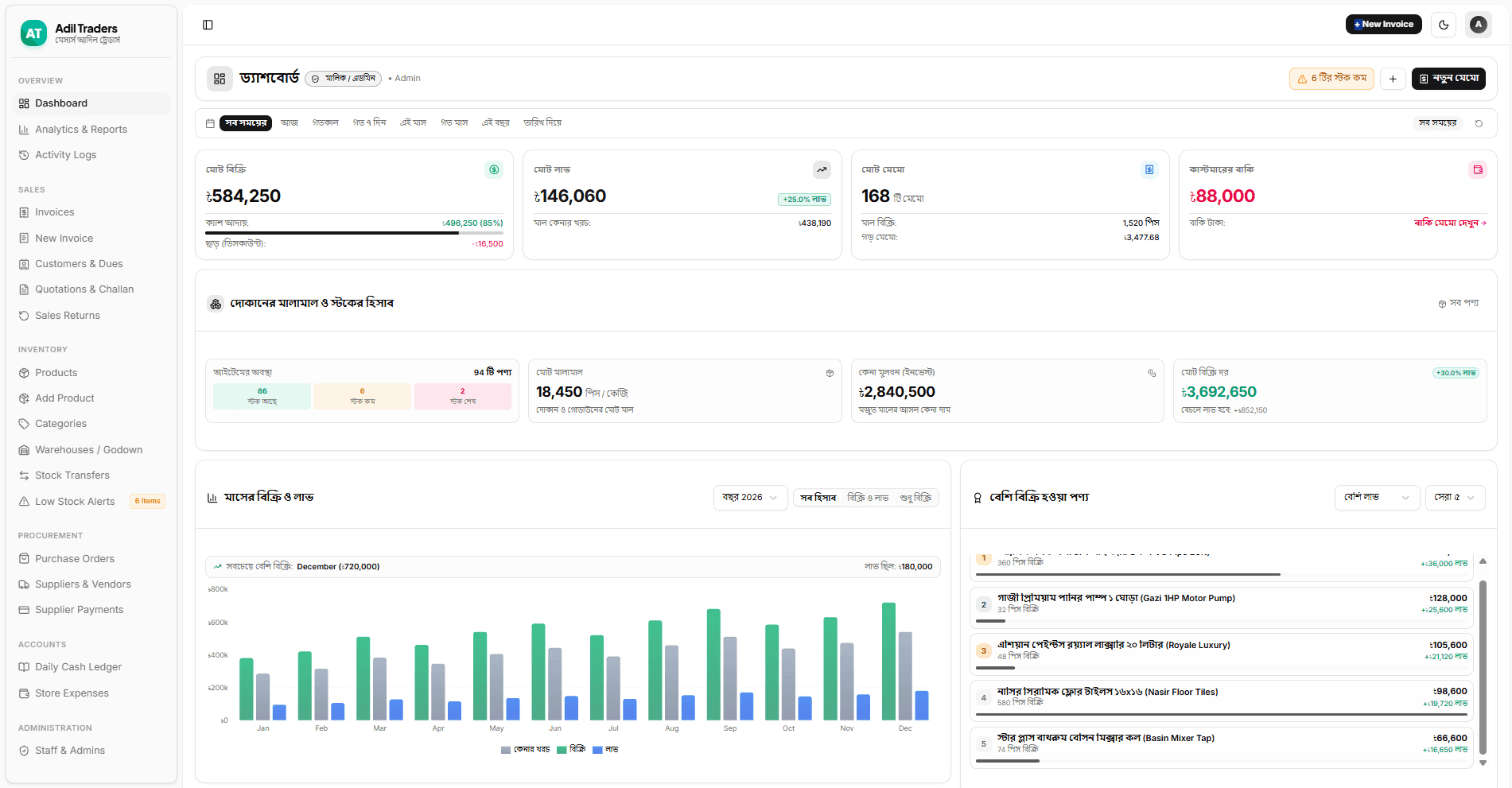
Executive Analytics Dashboard: Live tracking of Gross Revenue, Gross Profit, Profit Margin %, Cost of Goods Sold, customer credit totals, and threshold-based low-stock replenishment warnings.
The Experience: Making Things Easier
Deploying the platform changed daily shop operations immediately:
Thirty-Second Checkout: Cashiers select products, choose wholesale or retail pricing, specify weight, and print the cash memo in under thirty seconds.
No Below-Cost Selling: Automated floor-price checks prevent accidental or unauthorized loss-making discounts.
Immediate Debt Clarity: Customer balances are accessible in one click, showing complete transaction histories and eliminating ledger arguments.
Anywhere Management: Business owners can monitor shop revenue, profit margins, and inventory health from any computer, tablet, or smartphone.
Behind the Product: Technical Implementation
The application was built with modern, reliable technologies chosen for speed, auditability, and data security:
Frontend: React 19, Vite 7, TypeScript, Tailwind CSS v4, and Radix UI primitives deliver high responsiveness without interface bloat.
State Management: Redux Toolkit and RTK Query provide cached query data and optimistic updates.
Backend API: Express 5 on Node.js with strict Zod runtime schema validation prevents malformed requests from reaching business logic.
Data Layer: MongoDB and Mongoose handle relational structures for items, payments, and return records, using atomic update operators to prevent race conditions during peak checkout periods.
Document Generation: Client-side rasterization and vector rendering via html-to-image and jsPDF create crisp, printable vouchers on demand.
Security: HTTP security headers via Helmet, Mongo query sanitization, XSS protection, rate limiting, and structured logging safeguard application availability.
The Outcome: What Changed?
Deploying the custom management system transformed M/S Adil Traders into an agile, data-driven trading operation:
Every customer receives an accurate, professionally printed Bengali cash memo.
Below-cost discounts and mental math errors are completely eliminated.
Outstanding customer debts are tracked down to the exact taka with full historical logs.
Warehouse inventory matches physical counts, supported by automated return restocking and low-stock alerts.
The business owner has complete visibility into daily margins and collections from any device.
Conclusion
Wholesale and retail businesses do not need generic off-the-shelf software designed for corporate enterprises. They need practical, dependable digital products engineered around how their business actually operates.
Planex builds custom business management software, web platforms, and point-of-sale systems that eliminate operational bottlenecks. If your business is ready to replace paper ledgers and manual calculations with a custom software solution, get in touch with our team.
Have a project in mind? Let's build it together.
Planex delivers custom business software, scalable web applications, and high-performance digital products with fixed milestone pricing.