

Exchanger: Omnichannel Gadget Marketplace, Trade-In & POS Platform
How Planex engineered a unified retail, trade-in, and repair operating system for Kushtia's leading gadget business, transforming manual counter sales into an auditable digital platform with automated bKash checkout and POS memo printing.
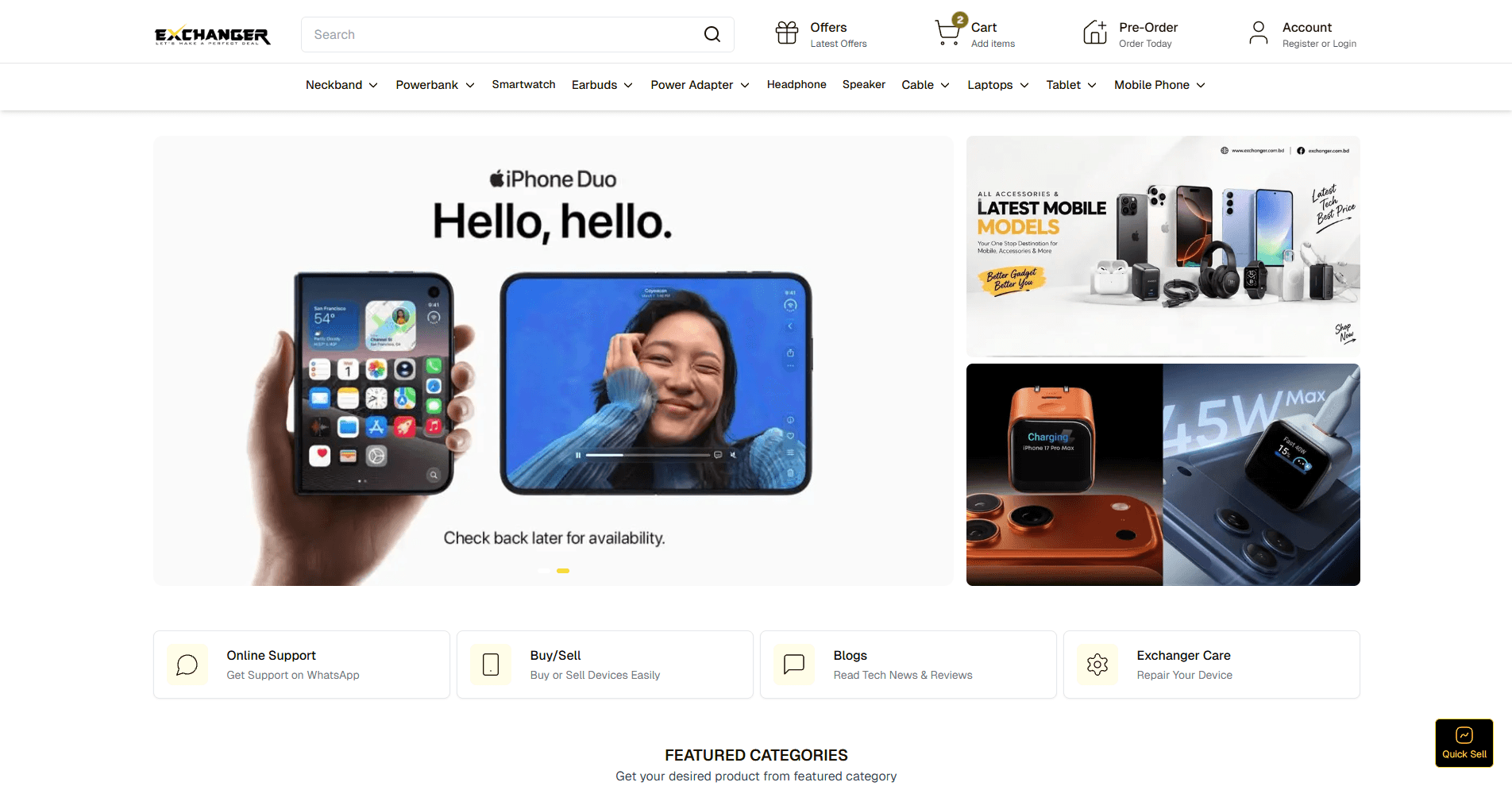
Services Delivered
Technologies Deployed
Business Outcomes & Impact
Engineering Case Study
A Regional Retail Leader with Growing Digital Demand
Exchanger began as a trusted retail destination located at Pach Rastar Mor in Kushtia Sadar, Bangladesh. Specializing in new and pre-owned smartphones, laptops, audio equipment, and accessories, the store built its reputation on two pillars: competitive trade-in valuations and honest post-sale support. As customer demand expanded beyond Kushtia to surrounding districts, the business faced a common retail challenge. Customers wanted to check current inventory online, calculate trade-in values for their existing phones, book certified repair services, and order devices for home delivery. At the same time, the physical store was processing dozens of walk-in sales, trade-in assessments, and service requests every day. Planex partnered with Exchanger to design, architect, and deploy a comprehensive software ecosystem. The goal was straightforward: modernize store operations without disrupting physical counter workflows, while launching a fast, reliable online storefront that makes buying, selling, and repairing gadgets straightforward for customers across Bangladesh.
The Problem: When Manual Workflows Limit Growth
Running a high-volume consumer electronics business involves far more complexity than standard retail. Each smartphone comes with specific variables: storage capacity, regional origin, physical condition grading, battery health, and warranty status. When operations depend on pen, paper, and messaging apps, bottlenecks quickly multiply.
Paper-Based Trade-Ins and Legal Vulnerability
In Bangladesh, trading pre-owned consumer electronics carries significant legal exposure. Retailers must ensure that every phone purchased from walk-in customers is legitimately owned and not reported stolen or disputed. Previously, staff recorded seller details by hand in paper notebooks and kept photocopies of National ID (NID) cards in physical filing folders. Matching a specific phone's IMEI number to a previous seller's handwritten record weeks later was time-consuming. If a receipt was misplaced, the store had no fast way to verify where a device originated.
The Pain of Manual POS Invoicing and Balance Tracking
Walk-in purchases frequently involve partial payments, trade-in offsets, and store credit. Store staff were writing receipts on printed memo pads by hand, calculating remaining balances with pocket calculators, and noting warranty terms manually. This created several operational difficulties:
Handwriting errors led to incorrect IMEI numbers on customer warranty cards.
Calculating outstanding customer balances required cross-referencing multiple paper slips at the end of each day.
Management had no instant way to view daily store revenue, total inventory asset value, or pending receivables without hours of manual tallying.
Disconnected Customer Touchpoints
Before the digital platform, customers who wanted to trade in a phone or inquire about a repair had to call the store or exchange dozens of messages across Facebook and WhatsApp. Store staff spent hours answering repetitive questions about device pricing, part availability, and store warranty policies, taking valuable time away from customers standing at the counter.
Fragile Payment Reconciliation
Online orders were confirmed through manual bank or bKash transfers. Customers had to send screenshots of their SMS confirmation, after which staff had to log into a physical merchant handset to verify the transaction ID. This manual verification caused delays in dispatching orders and created room for human oversight.
Understanding the People Behind the Problem
To build an effective solution, our team examined the everyday realities of everyone who interacts with Exchanger.
The Store Owners and Management
The founders needed clear financial visibility. They needed to know the total value of products on display, the gross margins between buying and selling prices on pre-owned stock, which devices were moving slowly, and how much credit remained uncollected. Above all, they needed peace of mind that their trade-in intake process was legally airtight and compliant with local authorities.
Sales Staff and Counter Technicians
Staff members were constantly switching context. Between attending walk-in buyers, testing used phones, filling out paper warranty memos, and replying to social media messages, they had little time to deliver personalized service. They needed a tool that let them generate accurate invoices in seconds, log trade-in details directly on a computer, and check component repair costs without searching through binders.
The Everyday Customer
Whether upgrading from an older Android phone to a flagship iPhone or searching for an affordable certified laptop for university, customers wanted transparency. They wanted to know the exact physical condition of a device, understand its specific warranty coverage (7 days replacement and 7 months service for used items; 15 days replacement and 1 year official for new items), and receive a clear, printed invoice with their phone's IMEI number clearly documented.
Our Approach: Building Around Real Store Workflows
Many software projects fail because they attempt to force an abstract e-commerce model onto an established physical business. We took the opposite approach: we studied the exact counter habits of Exchanger's staff and built digital systems that fit their natural operational cadence.
Decoupled Three-Tier Architecture
Rather than building a monolithic application, we engineered three independent layers:
The Consumer Storefront : Built with Next.js 16 to deliver sub-second page loads, structured search engine metadata, and a responsive mobile experience for shoppers nationwide.
The Operations Dashboard : A dedicated backoffice portal engineered with React 19, TanStack Table, and Recharts, providing fast data entry and real-time operational analytics for store staff and administrators.
The API and Business Engine : A modular Express and TypeScript service backed by MongoDB and Redis, handling payment webhooks, database integrity, file compression, and role-based permissions.
Respecting Established Habits: The Digital-Physical Memo
Exchanger had used high-quality printed paper memo pads for years. Customers recognized them and trusted the official stamp. Instead of replacing these memos with generic receipt printouts, we designed a software module that overlays dynamic invoice data directly onto the store's physical memo dimensions. Staff can generate a digital invoice in the system and print it directly onto their physical branded stationary, perfectly aligning every line item, IMEI number, and total figure.
The Solution: What We Built
1. Multi-Variant Gadget Catalog with Specification Filtering
Consumer electronics require nuanced product categorization. A smartphone cannot be listed as a single stock-keeping unit when it exists across multiple storage tiers (128GB, 256GB, 512GB), color options, regional variants (Japan, USA, Global), and condition grades (Brand New, Pre-Owned A-Grade). We built a three-tier hierarchical category system (Primary, Secondary, and Tertiary) backed by dynamic specification attributes.
How it works: When a customer visits a product page, selecting a storage tier or color variant updates the price, warranty terms, and live stock indicator in real time.
Why it matters: Customers see the exact price and warranty terms for the specific variant they intend to purchase, eliminating misunderstandings.
Side-by-side comparison: Customers can select multiple smartphones and view their technical specifications side by side in the comparison tool
/compare), evaluating display refresh rates, processors, and camera sensors to make confident purchasing decisions.
2. Verified Seller Intake and NID Archiving
To solve the compliance and security challenges of pre-owned inventory, we developed a mandatory seller verification workflow within the product management module.
How it works: Whenever staff acquire a pre-owned phone or laptop, the system requires the intake record to include the seller's full name, phone number, location, National ID number, front and back photos of their NID card, and a photograph of the seller. The device's unique IMEI number and initial buying price are permanently attached to this profile.
Why it matters: The store maintains a tamper-proof digital paper trail for every second-hand device in inventory. If local authorities or an original owner ever request verification, staff can retrieve the seller's complete identity within seconds.
Commercial impact: Gives retail customers confidence that every pre-owned gadget sold by Exchanger has been legitimately acquired and verified.
3. POS Invoicing and Physical Memo Calibration
We engineered an in-store Point of Sale (POS) invoicing system specifically tailored to counter operations.
How it works: Staff create a customer invoice by searching products or entering serial numbers. The system calculates sub-totals, records upfront cash or mobile payments, and logs any remaining due balance. Clicking "Print Invoice" uses browser print calibration to output the text cleanly onto Exchanger's pre-printed physical memo pads.
Why it matters: Every customer leaves the counter with an official receipt that clearly lists their device's IMEI number, customer phone number, transaction date, and warranty terms.
Automated Balance Tracking: The system automatically categorizes invoices as Paid, Partial, or Due, giving store management instant visibility into outstanding credit.
4. Component-Level Hardware Repair Booking
Repairing modern gadgets requires specialized diagnostic tracking. We built a dedicated Repair Catalog and booking interface /repair) that structures maintenance services around devices and replacement parts.
How it works: Customers select their device family (iPhone, iPad, MacBook, Apple Watch) and specify the repair they need—such as an OLED screen replacement, battery renewal, camera lens repair, or charging port service. Each service displays upfront pricing, component availability, and repair turnaround times.
Why it matters: Customers no longer have to wonder what a repair might cost or whether parts are in stock. They receive transparent estimates upfront, and store technicians receive structured repair tickets.
5. Automated bKash Mobile Payment Integration
To remove the friction of manual SMS verification, we integrated an automated bKash merchant gateway.
How it works: When a customer completes checkout online, they are routed through bKash's official tokenized payment interface. Once the customer authorizes the payment, bKash's webhook notifies our server, which verifies the transaction ID and immediately updates the order status from "Pending" to "Paid."
Why it matters: The customer receives instant confirmation with an order tracking code, while store staff receive an order that is already verified and ready to pack.
6. Customer Device Ads and Community Exchange
Beyond direct store purchases, we created a customer-facing classifieds system /ads) where gadget owners can list their devices for sale or trade.
How it works: Users post photos, condition descriptions, location, and asking prices. Store administrators review listings in the dashboard before publishing them to the public marketplace.
Why it matters: Keeps users engaged with the platform even when they are looking to trade peer-to-peer, reinforcing Exchanger's role as the central gadget hub in the region.
7. Executive Operations and Revenue Dashboard
Store management now has a central control room to monitor all business operations at a glance.
Financial Analytics: Displays total product valuation across the warehouse, total invoiced revenue, total payments collected, and outstanding customer dues.
Inventory Safeguards: Low-stock alerts identify fast-moving phones and accessories before they run out of stock.
Fulfillment Pipeline: Unified tabs for standard e-commerce orders, flagship pre-orders, and repair tickets allow staff to track customer requests from intake to delivery.
The Experience: Making Things Easier
For the Customer
A customer in Kushtia or any other district can visit the website, compare two smartphones, see clear photos of pre-owned models along with their warranty terms, and place an order using their bKash account in under two minutes. When visiting the physical shop, they receive an immediate printed warranty memo with their device IMEI clearly marked, providing genuine peace of mind.
For Counter Staff
Instead of hunting for paper folders or calculating trade-in margins on scratch pads, staff handle inquiries and sales through a clean interface. Recording a trade-in takes minutes, and creating a printed invoice takes seconds.
For Store Leadership
Business owners no longer spend late evenings tallying daily books. The dashboard provides an instant, accurate picture of daily revenue, collected cash, outstanding customer credit, and live inventory status.
Behind the Product: Reliable Engineering Choices
Every technical decision on the project served a direct operational purpose:
Next.js 16 App Router on Frontend: We chose Next.js to provide fast server-side rendering for catalog pages and SEO-critical content, combined with responsive client-side routing for dynamic filtering.
Relational Data Modeling within MongoDB: While electronics specifications vary, business data must maintain integrity. We used Mongoose middleware to validate category hierarchies (Primary, Secondary, and Tertiary) and enforce strict schema relationships between products, variants, and seller verification records.
Redis Cache Layer: Frequently accessed endpoints—such as the active banner promotions, category trees, and featured gadgets—are cached in Redis via
ioredis. This keeps catalog response times under 120ms even during promotional traffic surges.Dual Media Pipeline: Large images slow down mobile users. We implemented a hybrid media pipeline using Multer, Streamifier, Sharp, and Cloudinary. Device images uploaded by administrators or users are automatically compressed and served in modern WebP format, keeping bandwidth low on mobile connections.
Type Safety with TypeScript and Zod: Runtime validation using Zod ensures that every incoming API payload—from bKash callbacks to order submissions—meets strict structural requirements, preventing corrupt data records from entering the database.
The Outcome: What Changed?
By working closely with Exchanger's leadership, Planex delivered a complete transformation in how the business operates:
Unified Three Core Workflows: Replaced disconnected phone calls and paper notebooks with a unified platform handling retail sales, verified trade-ins, and hardware repairs in one place.
Eliminated Verification Bottlenecks: Replaced manual SMS checks with automated bKash gateway verification, allowing online orders to move immediately into fulfillment.
Auditable Intake Protocol: Every pre-owned gadget now has a verifiable digital history, protecting the store legally and building customer trust in certified pre-owned products.
Accurate Financial Records: The store now has an automated ledger tracking sales, received payments, and customer dues, eliminating the errors and stress of manual bookkeeping.
A Natural Closing
Modernizing a local retail business is not about replacing what makes it special. Exchanger built its success on personal relationships, fair trade-in valuations, and dependable after-sales care. By designing software around those existing strengths, Planex helped Exchanger turn operational bottlenecks into organized, scalable workflows. Today, the store operates with greater speed, lower risk, and a digital platform that serves gadget buyers and sellers across Bangladesh. If your retail or commerce business is outgrowing paper records, spreadsheets, and manual messaging, Planex can help you design custom software that fits your exact workflow. Let's start a conversation about what you need to build.
Have a project in mind? Let's build it together.
Planex delivers custom business software, scalable web applications, and high-performance digital products with fixed milestone pricing.